5 min readBy Iftekhar Priyo
You Finished Coding. Now What?
Many beginner developers can build applications but have no idea what happens after writing the code. This article explores what comes next and why cloud computing isn't as intimidating as it seems.
- Career
- Cloud
- DevOps
When I first started learning web development, my goal was simple.
Build features.
Learn React.
Learn Node.js.
Connect a database.
Finish projects.
And honestly, that's where many of us stop for a while.
We become comfortable writing code, fixing bugs, and adding new features. But eventually, a question appears that isn't answered by most tutorials.
"How does my application actually reach other people?"
Suddenly, we start hearing words like server, cloud, deployment, Linux, Nginx, Docker, and AWS.
At first, they sound like a completely different world.
A world that only DevOps engineers or senior developers understand.
So it's easy to think,
"I'll learn that later."
I thought the same.
But after spending time learning and experimenting with cloud technologies, I realized something important.
It's not nearly as mysterious as it sounds.
Most of us aren't confused because these concepts are difficult.
We're confused because nobody explains how they fit into the journey of building software.
Writing the Code Is Only Part of the Story
Imagine you've spent two weeks building a portfolio website.
Everything works perfectly on your laptop.
Now your friend asks,
"Can I see it?"
At that moment, you realize something.
Your application only exists on your computer.
If your laptop is turned off, nobody can use it.
So the next question naturally becomes,
"Where should this application live?"
That question leads us into a completely new part of software development.
Not writing code.
Running code.
This Is Where the Cloud Comes In
The cloud isn't a replacement for programming.
It's what allows your programs to exist outside your own computer.
Instead of keeping your application on your laptop, you can run it on computers that stay online 24 hours a day.
Those computers can serve users from anywhere in the world.
That's the simple idea behind cloud computing.
You're using someone else's computing infrastructure instead of buying and maintaining your own.
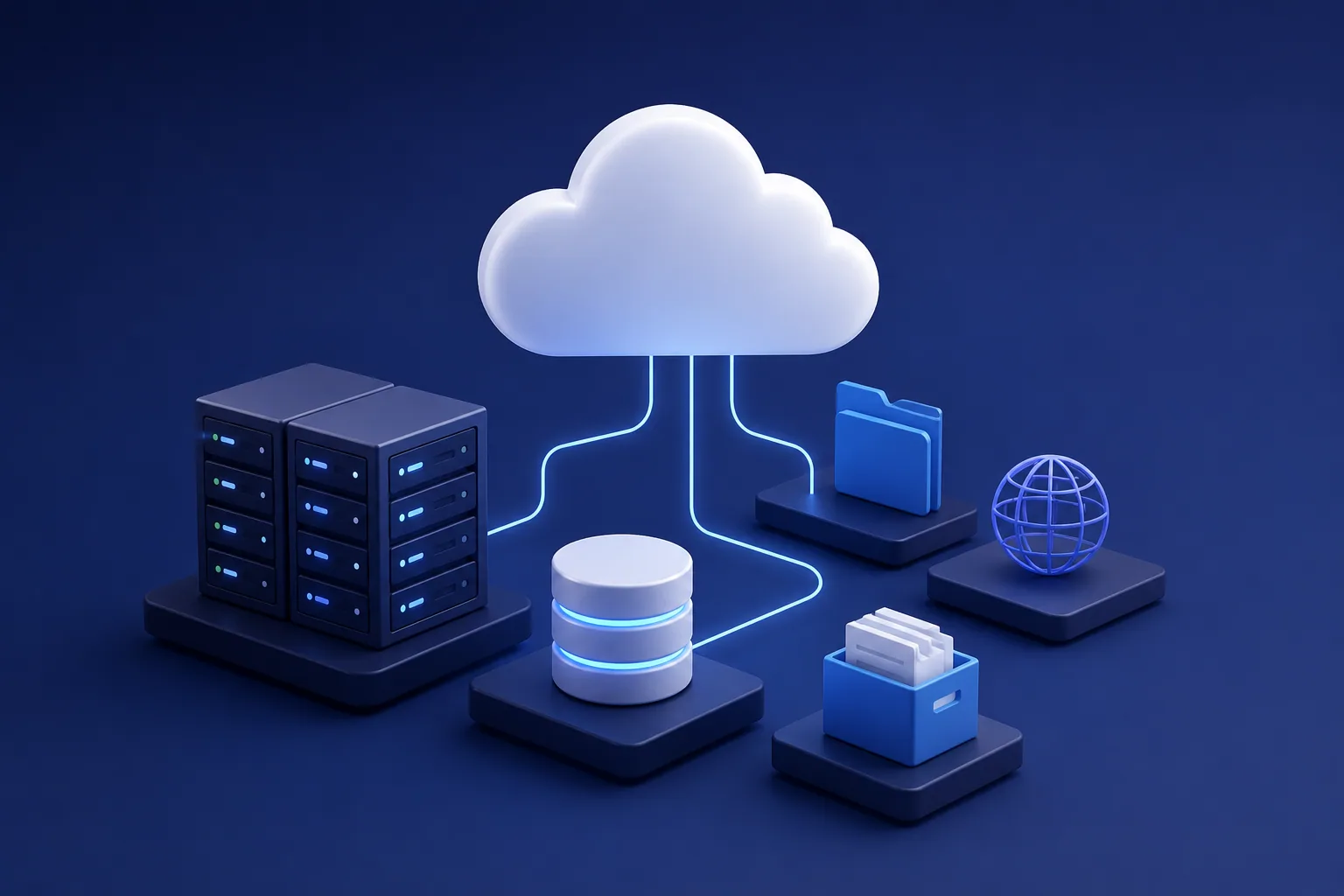
Cloud Is More Than Just Servers
Many people think the cloud only means renting a server.
In reality, cloud providers offer much more.
For example, they can provide:
- Computing power to run your applications.
- Storage for files such as images and videos.
- Managed databases.
- Networking that allows users to reach your application.
- Security features to help protect your services.
- Monitoring tools to understand what's happening inside your application.
Instead of building all of this yourself, you simply use the pieces you need.
Think of it as renting different parts of a computer system rather than buying an entire data center.
Convenience Is Great. Understanding Is Better.
Today, it's incredibly easy to deploy an application.
Platforms like Vercel, Netlify, and similar services can have your website online in just a few clicks. They're fantastic tools, and I still use them when they're the right fit.
But if your goal is simply to get a project online, you might miss an important part of the learning journey.
Questions like:
- Where is my application actually running?
- What happens behind the scenes when I deploy?
- How does my server stay online?
- Where is my database?
- How does my domain know where to go?
- What happens when thousands of users visit my application?
These are the questions that led me toward cloud platforms like AWS, Microsoft Azure, Google Cloud Platform (GCP), Ali Baba Cloud, Tencent Cloud.
They may require a little more setup than a one-click deployment platform, but they also help you understand how modern applications are built and operated.
For me, learning cloud isn't about making deployment more complicated.
As your applications grow, you'll start thinking about scalability, reliability, security, and handling real-world traffic. Learning cloud isn't about making deployment more complicated—it's about understanding how modern applications are built, deployed, and scaled.
Why I'm Writing About This
I've noticed that many beginner developers become comfortable building applications but hesitate when the conversation shifts toward hosting, servers, or the cloud.
Not because they aren't capable.
Because it feels unfamiliar.
I want to help make these topics feel less intimidating.
Not by throwing complex diagrams or enterprise architectures at you, but by explaining the ideas the way I wish someone had explained them to me when I started learning.
My goal isn't to make you memorize cloud services.
It's to help you understand why they exist and where they fit in the journey of building software.
What's Next?
This blog is where I'll document what I'm learning, building, and experimenting with.
Some articles will stay conceptual like this one, while others will be practical and hands-on.
I'll share how I deploy simple applications to the cloud, host projects on AWS EC2, connect domains, configure Nginx, secure applications with HTTPS, and explore the tools that make modern software run in production.
I'm not writing as someone who knows everything.
I'm writing as someone who's learning every day and wants to make that journey a little easier for the next person.
If you're a student, a beginner developer, or someone who's always wondered what comes after writing the code, I hope you'll find something useful here.
Thanks for reading, and I'll see you in the next article. 👋
Share this article
Send it to someone who might find it useful.